
Episode Summary
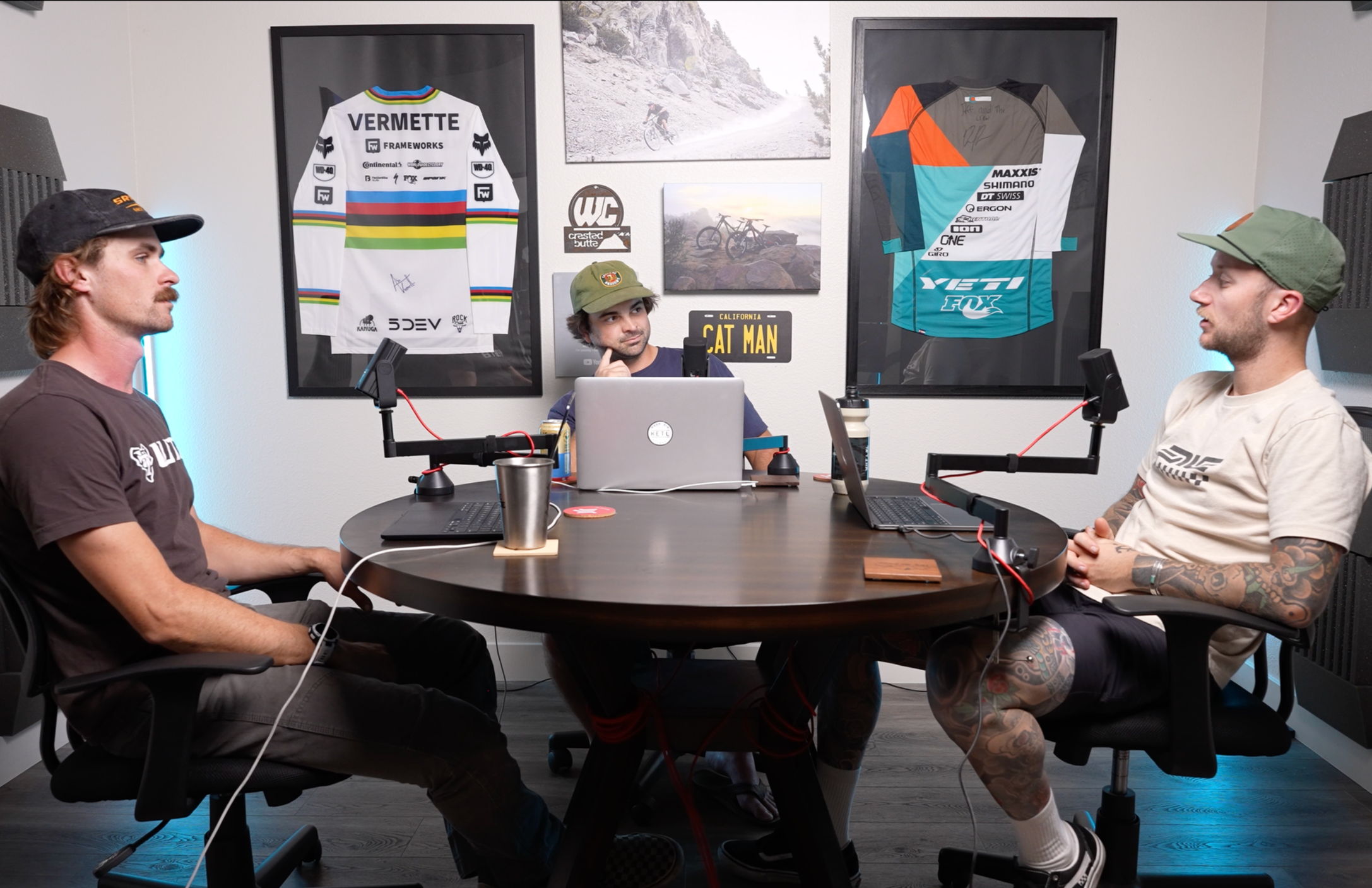
Today on the podcast, Jared, Liam and Tydeman discuss some of their epic recent rides, thanks to some moisture that finally made its way to Southern California. Then we discuss some bike setup epiphanies that have transformed the riding experience for us, before jumping into a classic set of listener questions ranging from optimizing a quiver to getting back in the saddle after a brutal injury and much more. Tune in!
Our YouTube channel: www.youtube.com/channel/UCxZoC1sIG-vVtLsJDSbeYyw
Worldwide Cyclery Instagram: www.instagram.com/worldwidecyclery/
MTB Podcast Instagram: www.instagram.com/mtbpodcast/
Submit any and all questions to podcast@worldwidecyclery.com
The MTB Podcast is presented by Worldwide Cyclery, the online retailer for serious mountain bikers.
Don't miss an episode – Subscribe now.
If you are one strange human that would like to read a transcript of the podcast above, continue reading below!
MTB Podcast — Episode 189 Summary
Here is a structured, cleaned-up summary of episode 190 of the MTB Podcast:
MTB Podcast — Episode 190 Summary
1. Intro & Openers
Zach’s Words of Wisdom: "At the end of the day, the things that you might think matter simply don't. Just go out and ride your bike." (Spurred by Zach repeatedly getting carded via an automated mobile-ordering app at local haunt Tarantula Hill Brewing).
Daniel’s Fun Fact: Nutmeg contains myristicin, a psychoactive compound that acts as a potent deliriant in large doses (1–3 whole nutmegs or 1–2 tablespoons ground). It triggers severe nausea, dry mouth, heart palpitations, and vivid hallucinations lasting up to 48 hours—an experience widely documented as physically dangerous and deeply unpleasant.
2. Recent Rides & Gear Impressions
Local Trail Conditions: Recent Southern California rains brought hero dirt; the hosts spent extensive time on big enduro bikes, digging trail work, and pedaling local hardtail loops.
ENVE XC28 Wheels on the Revel Ranger:
Specs & Pricing: ~1,516g (with tape and valves), retailing around $1,400.
Verdict: Highly rated as a premier value-to-weight option. Offers pinpoint stiffness, tracking, and cornering precision on a down-country frame without the deflection and harsh chatter associated with ultra-light flexy race wheels.
3. Cockpit Ergonomics & Setup Epiphanies
Fixing Wrist Pain & Body Positioning:
Bar Roll: Rolling handlebars forward slightly (rather than angled back toward the lap) dramatically relieved Jared’s chronic wrist pain and forced his body weight properly over the front tire into corners.
Brake Lever Inboard Spacing: Moving brake lever clamps further inboard (leaving roughly a finger-width or 20–25mm gap from the grip clamp) naturally kicks the elbows outward and aligns the wrists into a stronger "attack" posture. Liam uses a 15mm deep socket from his toolbox as a repeatable spacer.
Lever Angle: Flatter lever angles suit steep, sustained downhill riding to maintain a flat wrist; slightly steeper angles work better for flatter, rolling XC/trail terrain.
Pro World Cup Trends:
Jackson Goldstone runs an exceptionally tall stack and bars rolled far forward relative to his height (5'6").
Finn Iles runs a slammed stem with low-rise bars for an aggressive, low front end.
Reece Wilson runs the radical "Razer" reverse-offset stem setup.
4. Listener Questions
Q1: Tuning a Two-Bike Quiver (Ibis Ripmo V2 & Ripley V4S in Knoxville, TN)
The Situation: A 205-lb rider beefed up his Ripmo with a coil shock and 170mm Fox 38, but it now feels sluggish and overly heavy for local terrain, leaving him riding only the Ripley.
The Hosts' Verdict:
Keep the Bikes Distinct, But Rebalance the Front End: Don't turn them into identical trail bikes. Keep the Ripmo as the big bike, but replace the heavy 2,575g Fox 38 with a RockShox Lyrik (or Fox 36) set at 160mm/170mm, and swap the rear coil back to an air shock. This drops nearly 2 lbs off the bike while keeping it balanced and far more pedal-friendly.
Tire Casing Advice: Avoid 2.6" front tires—they tend to feel vague and squirm under hard cornering. Instead, stick to a 2.4"/2.5" Maxxis EXO+ or WTB Tough casing.
Q2: Fork Selection for a 190-lb Rider on a Revel Ranger (Pike vs. Fox 34 vs. Fox 36 SL)
Context: A 190-lb rider wants a fun, durable setup for stage races (e.g., Moab Rocks) and 4,000–5,000 ft Colorado trail rides.
Recommendation: Fox 36 SL (or RockShox Pike).
Why: At 190 lbs, a standard Fox 34 chassis will exhibit noticeable fore-aft and torsional flex under braking and hard cornering. The Fox 36 SL weighs virtually the same as a Pike (~1,755–1,778g), but its 36mm stanchions match the stiff, robust carbon chassis of the Revel Ranger perfectly.
Moab Rocks Tire Tip: Fast, low-profile tires like the Maxxis Aspen or WTB Macro excel on abrasive slickrock.
Q3: Buying a Dirt Jumper for Skills Progression (New vs. Used)
Recommendation: Buy used.
What to Look For:
Sizing: Look for an "average to long" reach frame (e.g., Transition PBJ Long, Specialized P.3, Revel Tweedy, or Marin Alcatraz) so the transition from a modern enduro bike doesn't feel overly twitchy.
Wheel Size: Stick with traditional 26-inch wheels (avoid 27.5" jump bikes).
Frame Material: Steel (4130 chromoly) offers great compliance and durability.
Priority Spec: Prioritize a quality dirt jump fork (RockShox Pike DJ or Marzocchi Bomber DJ) over lightweight components; dirt jumpers are simple, durable, and easily found on local buy/sell forums for hundreds below retail.
Q4: Returning to Riding After Major Surgery / Trauma (48-Year-Old Shoulder Reconstruction)
Safety Audits After a Hard Crash:
Helmets: If your head hits the ground, replace the helmet immediately. EPS foam crushes internally to dissipate energy on a single impact and cannot be verified by looking at the outer plastic shell. Replace riding helmets every 2–3 years regardless.
Carbon Handlebars: Critical failure point. Always inspect under the brake lever and grip clamps for indentations, crushing, or gouges. If scored, replace immediately.
Frame / Carbon Tubes: Perform the "coin tap" test along the tubes. A consistent sharp ping indicates structural integrity; a dull, muted thud signals internal delamination.
Mental Reset & Confidence:
Rebuild progressively in small increments (starting on flat green/fire road loops, advancing to blue flow trails, and gradually reintroducing technical features). Riding scared or tense creates stiff body posture that invites crashes.
Bike Setup for Upper-Body Rehabilitation:
Soften the Suspension: Drop fork air pressure by 5–8 PSI and open compression damping fully to minimize trail vibration transmitted through the healing shoulder/wrist joint.
E-Bikes for Upper-Body Rehab: Not recommended. While e-bikes assist leg fatigue, their heavy 45–55 lb mass exerts significantly more pulling, braking, and muscling force on the upper body and shoulder joints.
Protective Gear: Standard chest/back roost guards protect against abrasions, but cannot prevent joint dislocations or skeletal fractures. Dedicated shoulder braces (such as Space Brace or EVS) or electronic airbag vests (e.g., Alpinestars/Troy Lee Designs) offer functional joint and impact stabilization.